


How Taper Length Affects Paint Brush Filament Performance: What Actual Measurements Tell Us
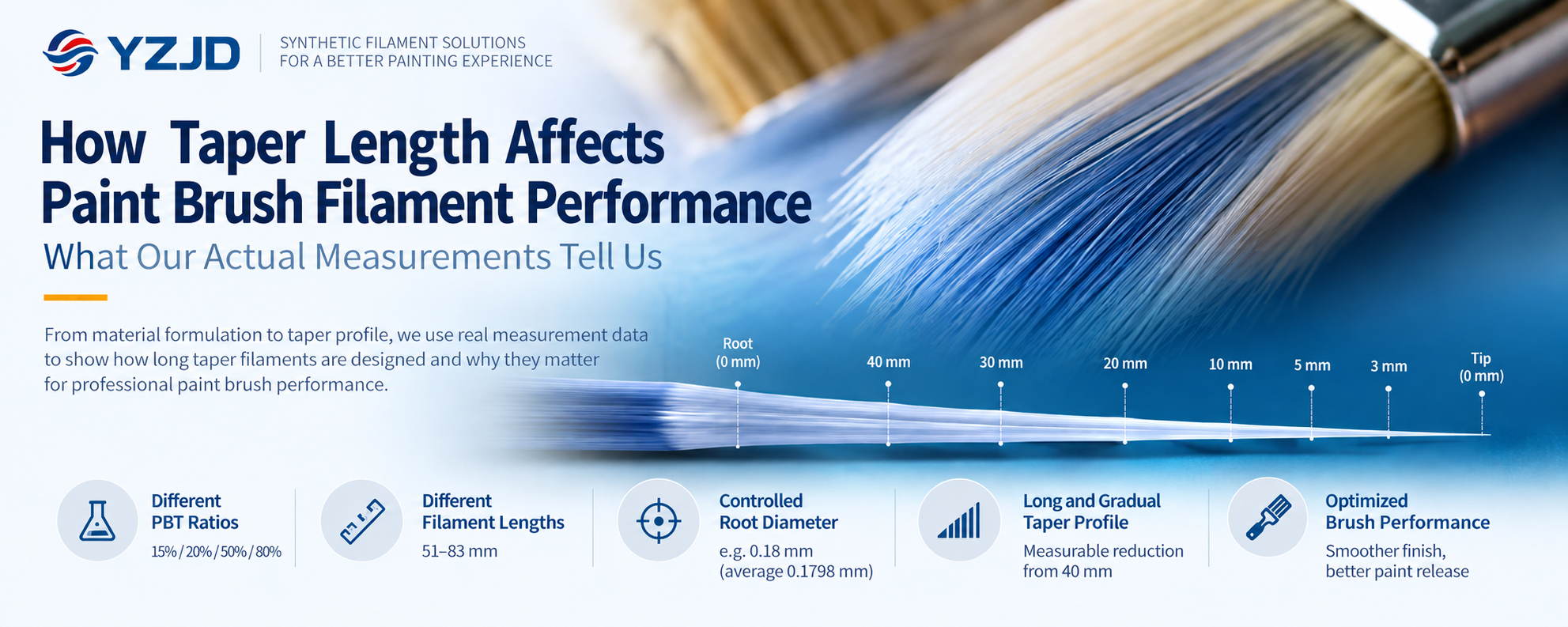
How Taper Length Affects Paint Brush Filament Performance: What Actual Measurements Tell Us
For professional paint brush manufacturers, filament diameter is only one part of the specification.
The taper profile—how gradually the filament diameter decreases from the root toward the tip—can have an important influence on flexibility, tip softness, paint release, brush marks and overall application performance.
However, one question is often overlooked:
How should the taper length of a paint brush filament actually be defined?
Is a filament with a 30 mm chemical treatment depth automatically a “30 mm taper”? Is 30 mm the maximum possible taper length? Does a shorter 51 mm filament have to use a shorter taper than a 76 mm filament? And will changing the PBT/PET ratio change the taper profile?
At YZJD, we studied these questions by measuring actual filament diameters at different positions along tapered PBT/PET paint brush filaments.
The results show that taper length should be understood from the actual diameter profile of the filament, rather than simply from the nominal chemical treatment depth.
1. What Is a Tapered Paint Brush Filament?
A tapered synthetic filament does not maintain the same diameter from root to tip.
Instead, the diameter gradually decreases as it approaches the tip.
For example, a filament may have a root diameter close to 0.18 mm, while the diameter becomes progressively smaller at 40 mm, 30 mm, 20 mm, 10 mm and finally near the tip.
This gradual transition creates a different mechanical structure from a straight, constant-diameter filament.
The root section provides much of the filament's stiffness and structural support, while the progressively thinner section provides increasing flexibility toward the tip.
This is one reason why taper design can influence the balance between:
stiffness and flexibility;
paint pickup and release;
shape recovery;
surface contact;
tip softness;
brush marks and finish quality.
Therefore, taper should not be considered only as a visual feature at the end of the filament. It is a structural characteristic extending along part of the filament length.
2. How Should Taper Length Be Defined?
A common way of describing tapered filament is to specify a nominal taper length, such as 20 mm, 30 mm or 40 mm.
However, there is an important distinction between:
chemical treatment depth
and
actual measured taper profile.
During chemical tapering, part of the filament is exposed to the treatment solution. The chemical concentration, processing time, temperature, immersion depth and filament formulation all influence the final result.
The physical transition in diameter does not necessarily begin at one perfectly defined point.
Instead, the diameter normally changes gradually.
For this reason, we believe a more useful way to evaluate taper length is to measure the filament diameter at multiple positions from the tip toward the root.
For example:
Root → 40 mm → 30 mm → 20 mm → 10 mm → 5 mm → 3 mm → Tip
This creates a diameter profile rather than relying on a single nominal taper-length number.
A useful principle is:
Taper length should be evaluated from the actual diameter profile, not simply defined by the chemical immersion depth.
3. Is 30 mm the Maximum Taper Length?
No.
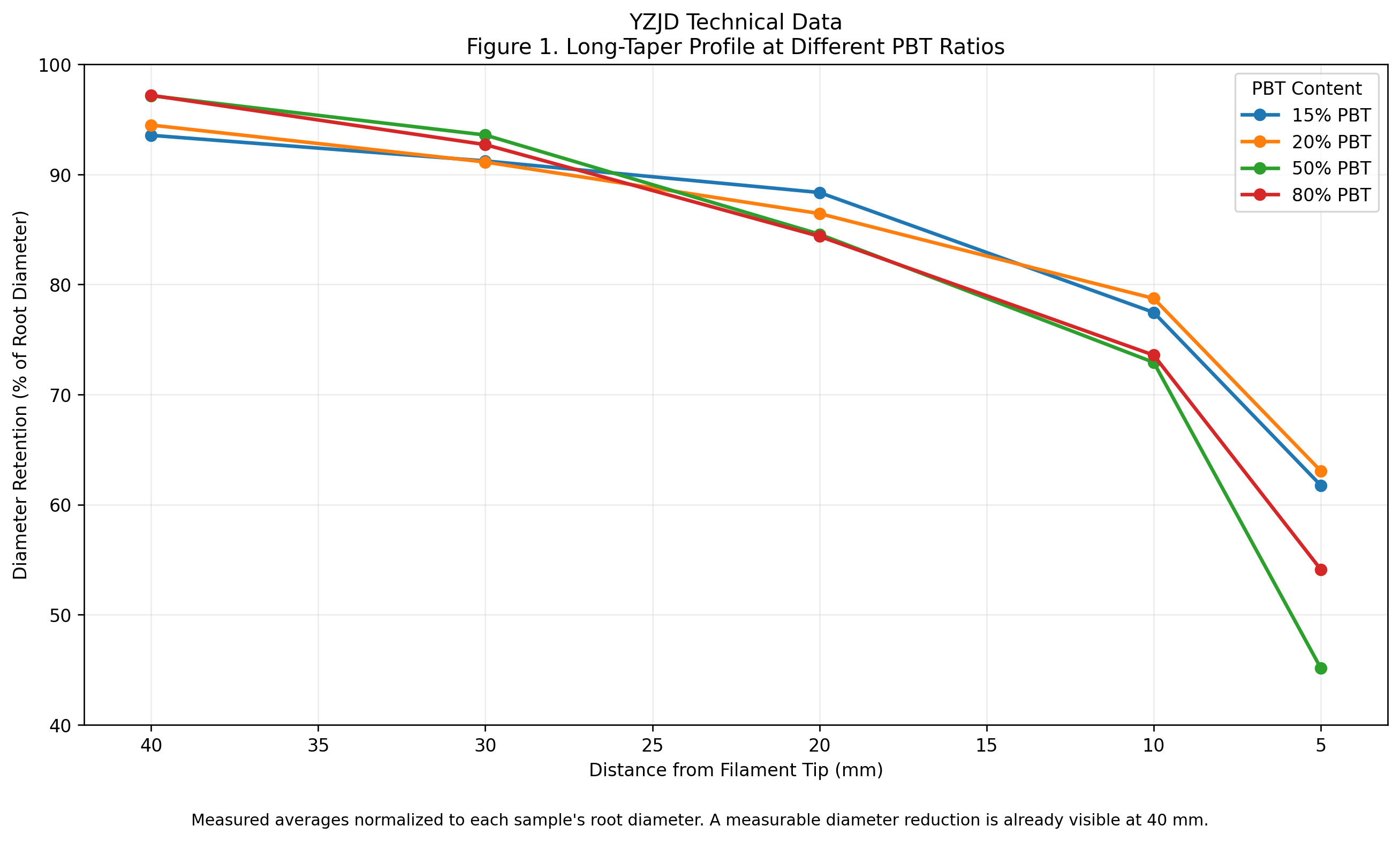
Our measurements show that the diameter reduction of some long-taper paint brush filaments can already be detected at approximately 40 mm from the tip.
In other words, the filament does not remain completely unchanged until 30 mm and then suddenly become thinner.
Instead, the transition is gradual.
In several formulations we measured, the diameter at 40 mm was already lower than the measured root diameter. The diameter then continued to decrease progressively at 30 mm, 20 mm, 10 mm and closer to the tip.
This means that describing these filaments simply as having a “30 mm taper” would underestimate the actual length over which the diameter is changing.
It is also possible to adjust the taper profile during production.
Depending on the filament formulation and required brush characteristics, processing parameters such as:
chemical concentration;
treatment time;
immersion depth;
treatment conditions;
can be adjusted to modify the resulting taper.
Therefore, 30 mm should not be regarded as a fixed maximum taper length.
4. Does the PBT Percentage Affect Taper Length?
PBT and PET have different physical and chemical characteristics, so changing the PBT/PET ratio can change how the filament responds during the tapering process.
This means that the same processing parameters should not automatically be used for every formulation.
At YZJD, we compared actual measurements from filaments with different PBT contents, including:
15% PBT, 20% PBT, 50% PBT and 80% PBT.
Because the original root diameters were not identical, directly comparing diameter in millimeters could be misleading.
We therefore normalized the measurements against each filament's measured root diameter:
Diameter Retention (%) = Measured Diameter at Position ÷ Root Diameter × 100
This allows the taper shapes of different starting diameters to be compared more meaningfully.
What did the measurements show?
All four PBT formulations demonstrated a gradual long-taper profile.
A measurable reduction in diameter could already be observed at approximately 40 mm from the tip.
The 50% and 80% PBT formulations were particularly interesting.
Although their starting diameters were different, their relative diameter reduction through a large part of the taper section was very similar.
For example, in one comparison:
| Position from Tip | 50% PBT – Diameter Reduction | 80% PBT – Diameter Reduction |
|---|---|---|
| 40 mm | approx. 2.8% | approx. 2.8% |
| 30 mm | approx. 6.4% | approx. 7.3% |
| 20 mm | approx. 15.4% | approx. 15.6% |
| 10 mm | approx. 27.1% | approx. 26.4% |
The similarity of these profiles demonstrates an important manufacturing principle:
Different PBT percentages do not necessarily require different final taper lengths.
Instead, the tapering parameters can be adjusted according to the formulation to achieve a comparable target profile.
This is why we do not treat PBT percentage and taper length as two completely independent fixed specifications.
The formulation and tapering process need to be designed together.
5. Can a 51 mm Filament Have a Long Taper?
Another common question is whether long tapering is only suitable for long filaments such as 70–80 mm.
Our measurements suggest that this is not the case.
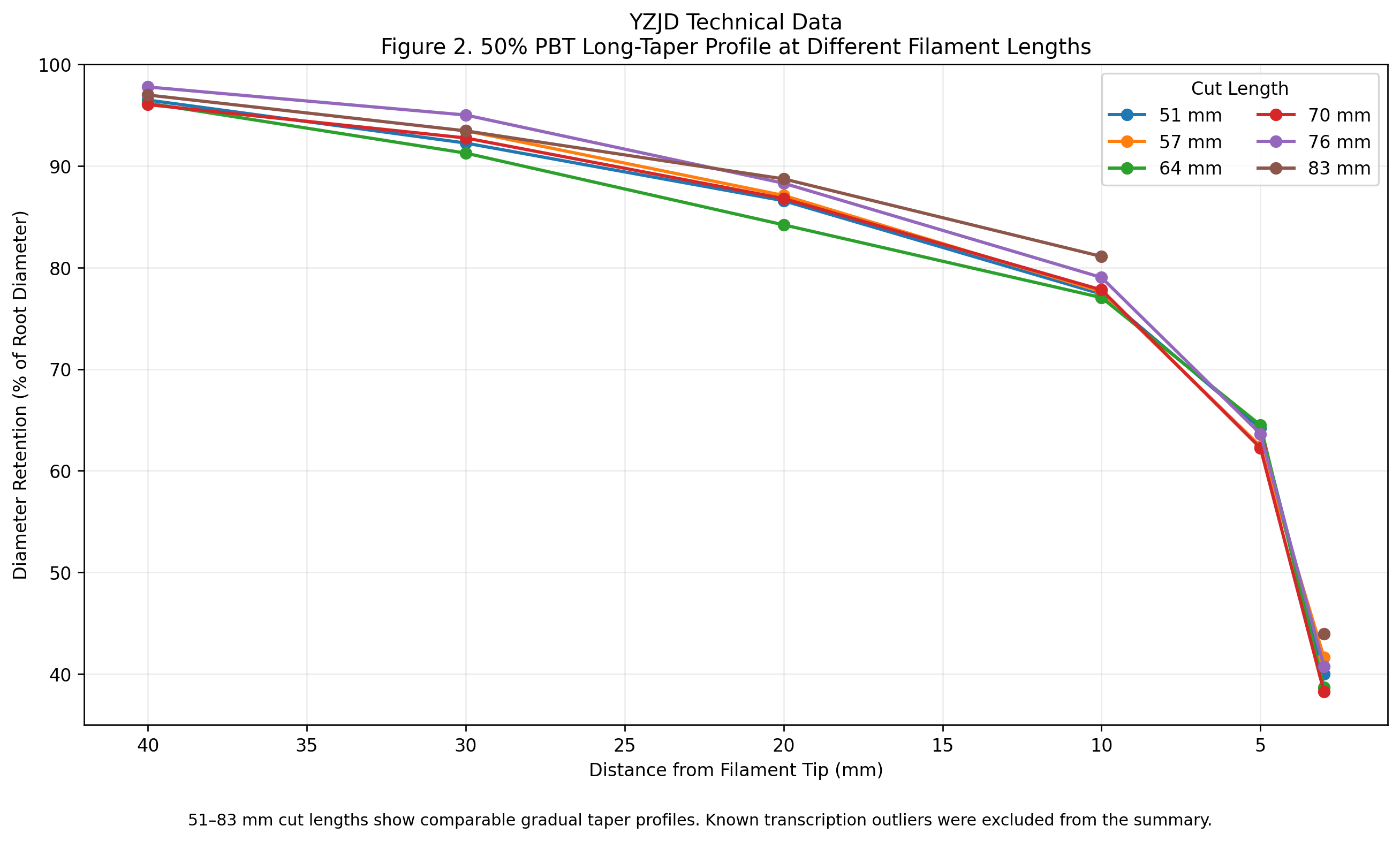
We compared 50% PBT filaments with several different cut lengths:
51 mm, 57 mm, 64 mm, 70 mm, 76 mm and 83 mm.
Using the same normalized diameter approach, the taper profiles of these different filament lengths were surprisingly close.
Most importantly, the 51 mm filament already showed measurable diameter reduction at approximately 40 mm from the tip.
For one 51 mm sample, the average measurements were approximately:
| Position | Average Diameter |
|---|---|
| Root | 0.1937 mm |
| 40 mm | 0.1869 mm |
| 30 mm | 0.1787 mm |
| 20 mm | 0.1677 mm |
| 10 mm | 0.1499 mm |
| 5 mm | 0.1243 mm |
| 3 mm | 0.0775 mm |
The important point is not simply the final tip diameter.
The data show a continuous reduction from the upper taper region toward the tip.
Therefore, a long taper is not limited to 76 mm or 83 mm filaments.
A shorter 51 mm filament can also be designed with a long and gradual taper profile.
6. If the Specification Is 0.18 mm, Will the Root Still Measure 0.18 mm?
This is an important question because chemical tapering intentionally reduces filament diameter.
The answer depends on which part of the filament is being measured.
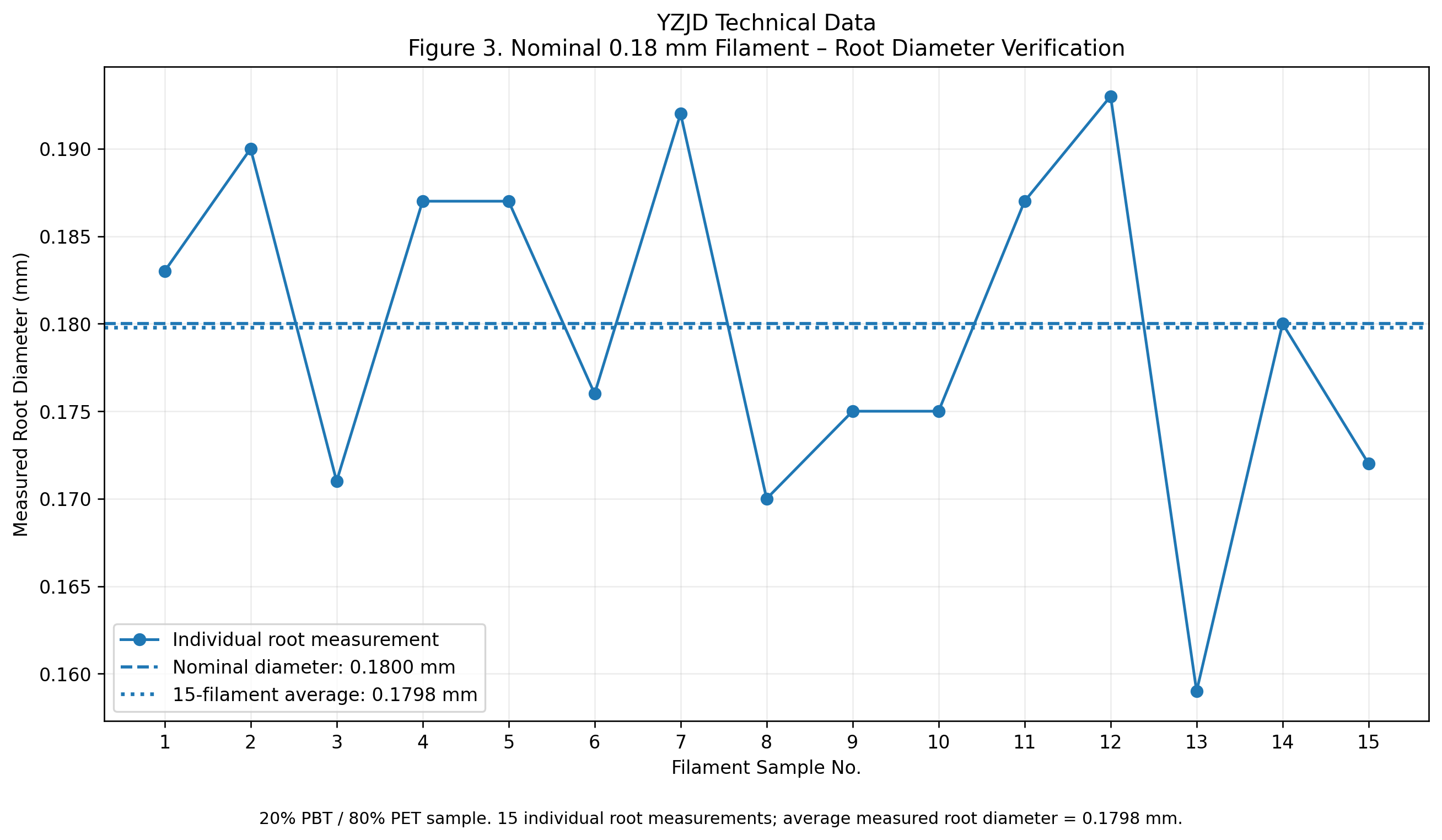
When we specify a filament as 0.18 mm, our production target is for the average diameter of the root/base section to be approximately 0.18 mm.
Individual filaments naturally show some diameter variation. Therefore, production control should not be interpreted as requiring every individual filament to measure exactly 0.1800 mm.
Instead, multiple individual filaments are measured to evaluate the production average.
Actual 0.18 mm measurement example
We measured 15 individual root diameters from one:
0.18 mm, 20% PBT / 80% PET tapered filament sample.
The result was:
Nominal diameter: 0.1800 mm
Average measured root diameter: 0.1798 mm
The average of the 15 measurements was therefore extremely close to the nominal 0.18 mm specification.
This illustrates an important distinction:
Chemical tapering is intended to progressively reduce the diameter of the tapered section—not to redefine the nominal root diameter of the filament.
The expected diameter change during tapering must therefore be considered when establishing the production process.
7. Is a Longer Taper Always Better?
Not necessarily.
A longer or finer taper can increase flexibility toward the tip and change how the filament contacts the painted surface.
However, professional paint brush performance is determined by the complete filament system rather than one measurement alone.
Important variables include:
root diameter;
taper length;
tip diameter;
PBT/PET ratio;
filament stiffness;
filament length;
straight or crimped filament;
filament blend;
brush thickness;
filament density;
paint type;
desired paint pickup and release characteristics.
For example, an extremely fine and flexible tip may be desirable for a smooth finish, but excessive flexibility may reduce the stiffness or control required for another application.
Therefore, the objective should not simply be:
“Make the taper as long as possible.”
A better objective is:
Design the taper profile that provides the required balance of stiffness, flexibility, paint loading, release and finish quality for the intended brush.
8. Why Filament Blending Matters
Professional paint brush filament mixtures do not always need to use one identical filament throughout the entire brush head.
Different filament characteristics can be combined to obtain a particular performance.
For example, one part of a blend may use a higher PBT content to provide greater stiffness and shape recovery, while another part may use a different PBT/PET ratio to modify flexibility and painting characteristics.
Different filament diameters can also be blended.
This gives the brush manufacturer another level of control beyond simply selecting “30% PBT” or “80% PBT.”
The final brush performance therefore depends on three related levels of design:
Material formulation → Taper profile → Filament blend
Optimizing these together is more meaningful than evaluating any one specification independently.
9. Taper Profile Should Be Measured, Not Assumed
Our measurement work highlights a simple but important point.
A tapered paint brush filament cannot be fully described by only:
“0.18 mm × 60 mm, 30 mm taper.”
A more complete technical description should consider:
actual average root diameter;
diameter at different distances from the tip;
taper progression;
tip diameter;
material composition;
cut length;
intended brush application.
By measuring the filament at several positions, manufacturers can understand the actual geometry of the taper instead of relying only on a nominal processing parameter.
This also makes it easier to compare different formulations and reproduce the same filament performance from batch to batch.
Conclusion
Long-taper paint brush filament is not simply a filament with a thin tip.
It is a controlled transition in diameter from the stronger root section toward the finer and more flexible tip.
Our measurements of different PBT/PET formulations and filament lengths show that:
A measurable diameter reduction can already occur around 40 mm from the tip.
30 mm is therefore not necessarily the maximum taper length.
Shorter filaments such as 51 mm can also achieve a long and gradual taper profile.
Different PBT percentages—including 15%, 20%, 50% and 80% PBT—can achieve comparable long-taper profiles when the tapering process is adjusted for the formulation.
For a nominal 0.18 mm filament, actual production measurements can maintain the average root diameter very close to the specified value; in one 15-filament test, the measured average was 0.1798 mm.
Most importantly, taper should not be evaluated by one number alone.
For professional paint brush applications, the more useful approach is to evaluate the complete diameter profile and design it together with the filament material, stiffness, length and blend.
At YZJD, we can develop and measure different PBT/PET filament formulations and taper profiles according to the required paint brush application.
For customers developing professional paint brushes, sample formulations can be prepared for comparative brush-making and painting tests.


