


Why Do Some Paint Brushes Leave Brush Marks? How Filament Taper Length Affects Paint Finish

Why Do Some Paint Brushes Leave Brush Marks? How Filament Taper Length Affects Paint Finish
Why a continuous taper of approximately 30 mm directly affects brush marks, tip softness, and paint finish
Key conclusion: Tapered filament cannot be evaluated solely by asking whether the tip is fine enough. Performance depends on sufficient taper length, a continuous and uniform diameter transition, and the correct balance between tip softness and body support. |
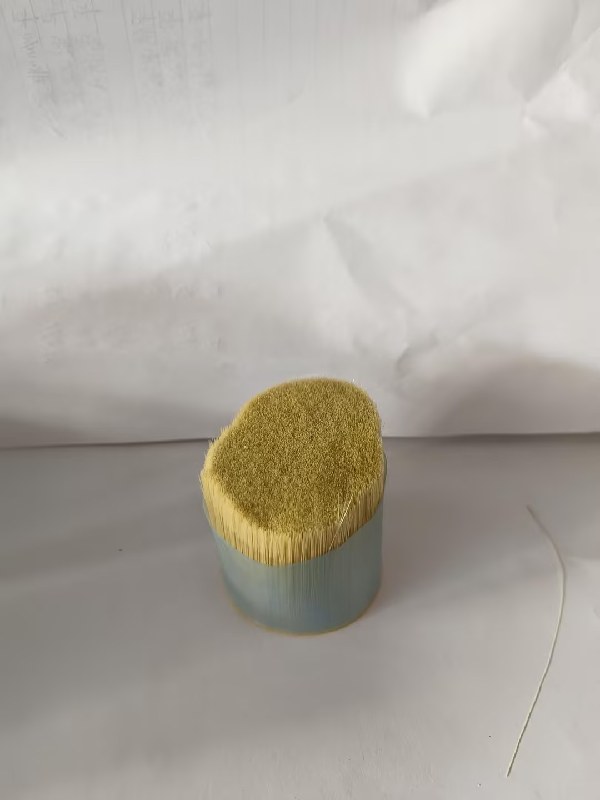
Figure 1. Nonconforming tapered filament rejected during our factory quality inspection because the tapered section is too short.
Figure 1 shows a defective sample removed by our quality-control team. Although the tip appears fine, the tapered section is too short and the diameter decreases too rapidly. The transition from the filament body to the tip is therefore too abrupt. If this filament were used in a paint brush, it could adversely affect tip flexibility, recovery, paint release, and the final painted surface.
1. Why an insufficient taper can produce visible brush marks
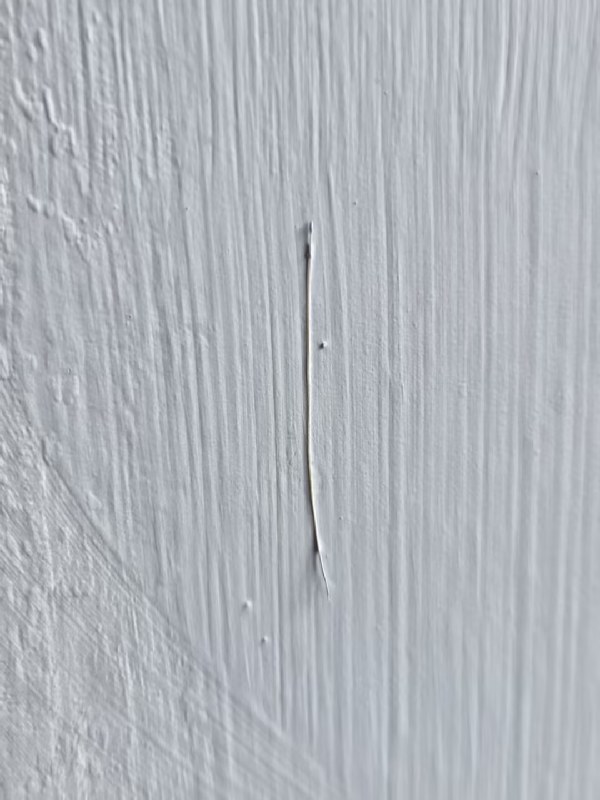
In our factory inspection, tapered filament with an excessively short tapered section is classified as nonconforming. It lacks sufficient transition distance between the full-diameter body and the fine tip, so the filament cannot spread smoothly and continuously when it contacts the wall. On rough surfaces in particular, it follows surface irregularities poorly and is more likely to leave distinct linear brush marks.
|
|
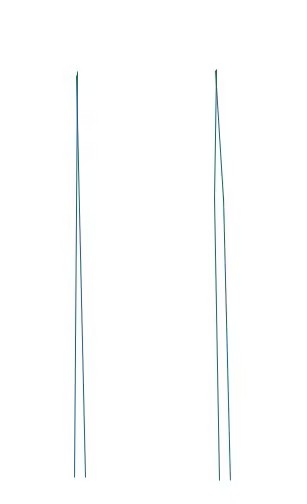
Figure 2. Distinct linear brush marks on a rough wall surface. | Figure 3. Visual comparison of a long tapered section and a short tapered section. |

2. Taper quality cannot be reduced to “larger is better” or “smaller is better”
At least three values must be stated when describing a filament taper: the original diameter D₀, the minimum tip diameter Dₜ, and the tapered-section length L. Describing the taper as merely “large” or “small” can confuse taper length, taper angle, and tip diameter.
Parameter | Measured/target value | Meaning | Quality focus |
Original diameter D₀ | 0.16 mm | Diameter of the untapered body | Determines basic support |
Tapered-section length L | Approx. 30 mm | Begins approx. 30 mm from the end and decreases toward the tip | Determines whether the transition is sufficiently gradual |
Minimum diameter Dₜ | Approx. 0.009 mm | Minimum measured value near the tip | Affects tip softness |
Total diameter reduction ΔD | 0.151 mm | 0.16−0.009 | Shows the total reduction in diameter |
3. The 30 mm transition of a 0.16 mm tapered filament
For a 0.16 mm solid filament, the diameter begins to decrease approximately 30 mm from the end and continues to reduce toward the tip, reaching approximately 0.009 mm at the finest point. Chemical tapering does not create a perfectly straight, machined cone. Instead, the diameter decreases progressively along the filament. Quality evaluation should therefore focus on whether the entire transition is smooth, continuous, and stable.
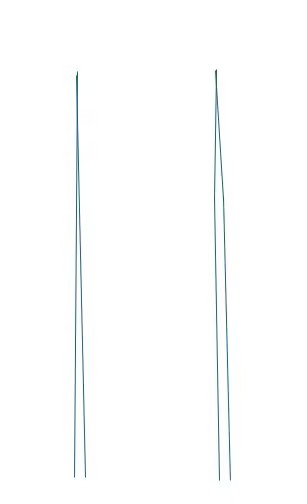
Figure 4. Left: a longer, more gradual taper. Right: a shorter, steeper taper.
Quantitative results based on the measured parameters
Calculation | Result | Explanation |
Average diameter-reduction rate ΔD/L | 0.00503 mm/mm | For each 1 mm of length, diameter decreases by approx. 0.00503 mm |
Length-to-diameter-reduction ratio L/ΔD | 198.7:1 | For process comparison using the same specification and measurement method |
Equivalent linear half-angle | Approx. 0.144° | Geometric reference only; not a substitute for sectional measurements |
Note: These calculations simplify the tapered section as a linear cone in order to express the overall gradient of the 30 mm transition. The actual profile produced by chemical tapering is affected by the material, solution, temperature, processing time, and bundle condition. Final acceptance should therefore be based on sectional measurements and actual painting performance.
4. Sectional measurement: the diameter decreases progressively, not abruptly
|
|
Figure 5. Approx. 0.151 mm near the filament body. | Figure 6. Approx. 0.147 mm farther toward the tip. |


5. Measurement images show a continuous diameter-reduction trend
Measurements taken at different positions show that the diameter decreases progressively along the tapered section. The original measurement images record stages of approximately 0.151, 0.147, 0.127, 0.103, 0.089, 0.073, 0.054, 0.040, and 0.025 mm, with the finest point reaching approximately 0.009 mm. A single reading does not define taper quality; the key is a continuous and stable reduction trend.

|
|
Figure 7. Approx. 0.127 mm in the middle section. | Figure 8. Diameter further reduced to approx. 0.103 mm. |
|
|
Figure 9. Approx. 0.089 mm closer to the tip. | Figure 10. Diameter further reduced to approx. 0.073 mm. |
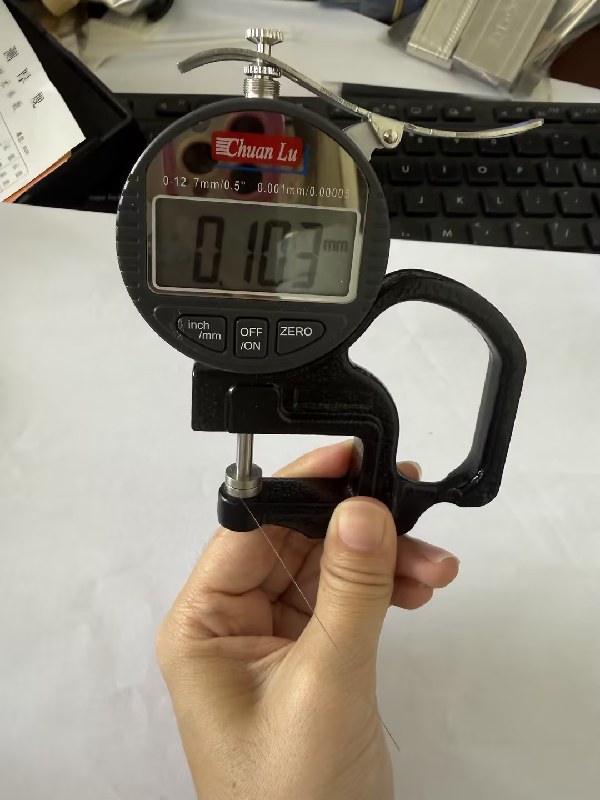
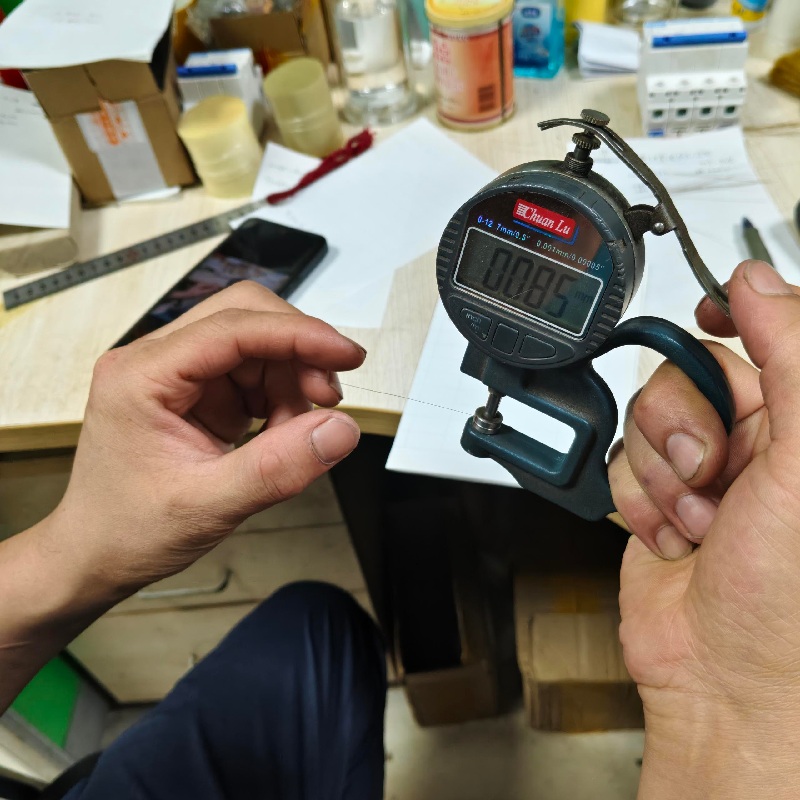
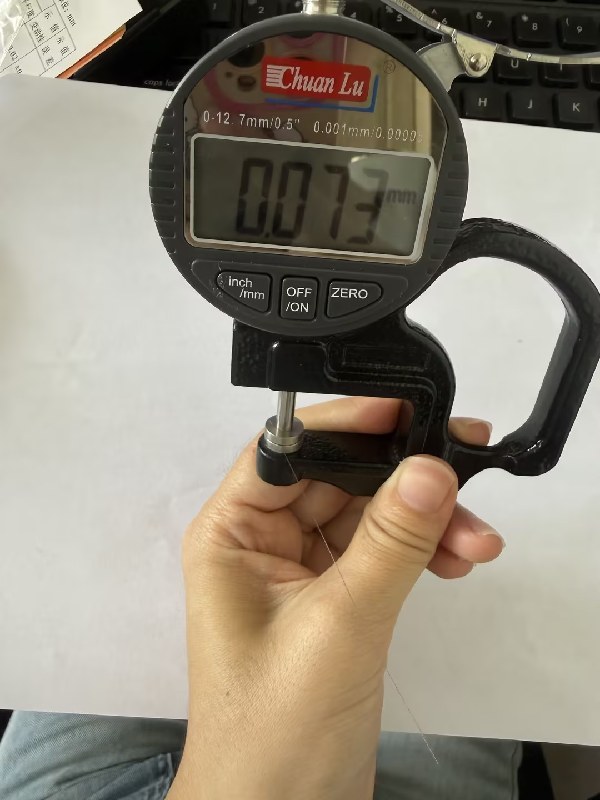
Additional measurement images show readings of approximately 0.054, 0.040, and 0.025 mm closer to the tip, before the filament reaches approximately 0.009 mm at its finest point. The clamping position, measuring pressure, and instrument zeroing method should be kept consistent so that operating error is not mistaken for process variation.
6. Why a 30 mm tapered section is more gradual than a 10 mm section
If the original diameter and minimum tip diameter are the same, a shorter tapered section must complete the same diameter reduction over a shorter distance. For D₀ = 0.16 mm and Dₜ = 0.009 mm:
Tapered-section length | Average diameter-reduction rate | Relative to 30 mm taper | Profile characteristic |
30 mm | 0.00503 mm/mm | 1.0× | Longer transition distance and a more gradual profile |
10 mm | 0.01510 mm/mm | Approx. 3.0× | The same diameter reduction occurs over a shorter distance, creating a steeper profile |
Therefore, under otherwise identical conditions, a 10 mm tapered section is not necessarily “sharper”; it is steeper. A 30 mm tapered section provides more distance for the same diameter change. This does not mean that a longer taper is always better. If the tip is not sufficiently tapered, the required minimum diameter is not achieved, or the chemical process cannot produce a stable and continuous transition, the result will still be unsatisfactory.
7. Direct effects of the tapered profile on paint brush performance
Tip softness: A finer tip spreads more gently on contact with the wall, helping to reduce linear marks caused by stiff filament ends.
Body resilience and support: The tapered section transitions from the 0.16 mm body to a fine tip. The body retains support, while the tip provides surface conformity and finishing performance.
Paint release and uniformity: A continuously tapered tip follows the brushing motion more smoothly, reducing localized paint build-up and abrupt drag lines.
Adaptability to rough surfaces: Softer tips enter small surface irregularities more easily and improve continuity of coverage.
8. Recommended quality inspection method
Tapered-filament quality cannot be assessed solely by visually checking one tip or recording one minimum diameter. A more reliable inspection combines dimensional data with actual application performance.
1. Confirm the body specification: Verify that the original diameter in the untapered area is stable, for example 0.16 mm.
2. Confirm the taper starting point: Check that the filament begins to decrease in diameter approximately 30 mm from the end.
3. Measure at multiple positions: Take measurements along the tapered section to confirm an overall continuous reduction rather than an abrupt change.
4. Verify the finest point: Confirm that the finest point reaches approximately 0.009 mm, while checking for over-etching, brittleness, breakage, or excessive dimensional variation.
5. Check bundle consistency: Verify that the taper length and tip condition are uniform within the same bundle.
6. Perform an application test: Brush both smooth and rough surfaces and evaluate brush marks, spreading, recovery, paint release, and final finish.
Conclusion
For a 0.16 mm solid tapered filament, the target profile described in this article begins to decrease continuously approximately 30 mm from the end and reaches approximately 0.009 mm at the finest point. Taper quality should not be judged by simply pursuing a “smaller taper” or a “finer tip.” The tapered-section length, uniformity of transition, tip softness, and body support must be properly balanced. Only then can the filament reduce brush marks, conform better to the wall surface, and improve the uniformity of the painted finish. |

Figure 11. Approximately 0.025 mm near the tip; the finest point further decreases to approximately 0.009 mm.


